Strategic Liquidity of Listed Equity Investments
Get institutional-grade funding against equity shares held in demat, without disturbing long-term portfolio positioning.
LAS Division of Terkar Capital arranges liquidity solutions for promoters, HNIs, directors, investors and business owners seeking capital efficiency against their listed equity assets.
Built for structured lending, not retail lending.

Institutional Liquidity Backed by Listed Equity Assets
Loan Against Shares (LAS) allows borrowers to leverage approved listed equity holdings to gain structured working capital, promoter funding, acquisition support, bridge liquidity or treasury flexibility.
At Terkar Capital, LAS is being pitched as a strategic balance sheet instrument and not as a retail loan product.
Our approach focuses on:
This structure is commonly utilized for:
.png)
Eligible Share Categories
Listed Equity Holdings – Approved
The equity holdings are classified on the basis of underlying quality , liquidity and the market it is on which determines its eligibility for funding .
Typically eligible categories are:
Group A Listed Shares
Large-cap stocks that are institutionally traded, have good liquidity and market participation.
Group B Approved Shares
Good fundamental mid-cap stocks approved by lenders and within exposure limits.
Promoter Holdings
Structured pledge mechanism against eligible holdings held by promoters.
Institutional Portfolios
Expertly managed investment portfolios diversified across exposure.
Demat-Held Equity Investments
Individual and corporate demat holdings as per the lender’s criteria.
Group A / Group B Share Classification
Approved Listed Equity Holdings
.png)
.png)
Strategic Applications of LAS Structures
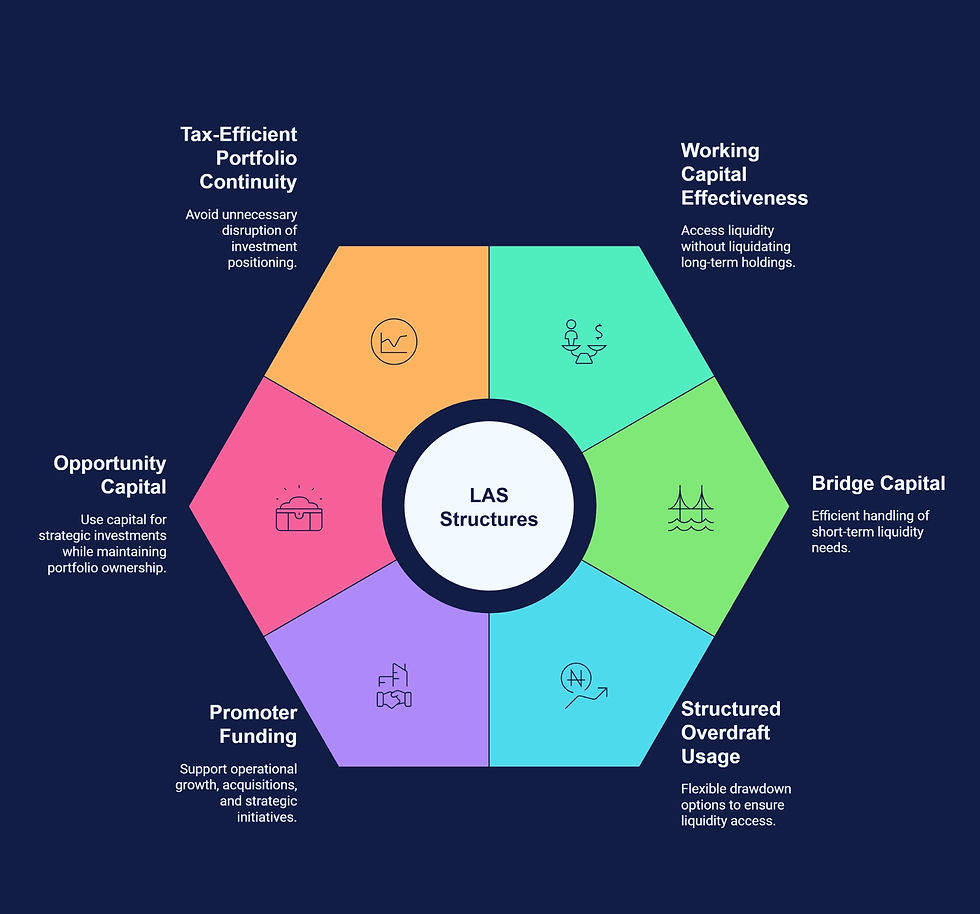
Loan-to-Value Structuring Framework
Loan-to-Value (LTV) is the ratio of how much you can borrow against your approved equity holdings.
*Rather than maximizing leverage, the objective is sustainable liquidity management.
The structure is affected by:
-
market variations
-
concentration risk
-
sponsor risk
-
portfolio diversification
-
sector risk
-
marketability of stock
-
lender policy systems
Institutional LAS structures usually emphasize:
-
disciplined collateralization
-
dynamic margin monitoring
-
exposure management
-
cautious leverage postion
Institutional Risk Governance
Terkar Capital’s LAS structuring philosophy prioritizes capital preservation and disciplined risk assessment.
Risk evaluation frameworks generally include:
Portfolio Volatility Analysis
Study of current and historical market movement.
Margin Monitoring
Monitoring of continuous collateralization.
Concentration Analysis
Stock-wise and sector-wise concentration assessment.
Review of Promoter Exposure
Review of current pledge and leverage arrangements.
Liquidity Stress Testing
Assess the ability to exit the market in different volatility situations.
Regulatory Compliance Alignment
Structuring in accordance with lender and market requirements.
Portfolio Volatility Analysis
Study of current and historical market movement.
Terkar Capital’s LAS structuring philosophy prioritizes capital preservation and disciplined risk assessment.
Institutional Risk Governance
Margin Monitoring
Monitoring of continuous collateralization.
Concentration Analysis
Stock-wise and sector-wise concentration assessment.
Gold Price Monitoring
Review of market-linked valuation movements.
Review of Promoter Exposure
Review of Promoter Exposure
Review of current pledge and leverage arrangements.
Liquidity Stress Testing
Assess the ability to exit the market in different volatility situations.
Regulatory Compliance Alignment
Structuring in accordance with lender and market requirements.
Flexible Structured Liquidity Access
Most LAS structures are offered in the form of an overdraft (OD) facility.
-
draw funds as needed
-
optimize interest use
-
manage treasury flexibility
-
maintain a discipline of operational liquidity
This allows borowers to :
Key Structural Benefits
-
interest paid only on amount used
-
revolving access to cash
-
efficient short-term capital management
-
faster operational deployment
-
structured borrowing with collateral
The aim is flexibility and institutional control.
Frequently asked questions
Structured Liquidity Begins with Institutional Evaluation
Terkar Capital’s Strategic LAS Division assists promoters, HNIs, and businesses in structuring disciplined liquidity solutions against financial assets.